Ethereum Price Forecast: Expert Predictions and Analysis

Ethereum stands at the crossroads of technological innovation and financial speculation. As the world’s second-largest cryptocurrency by market capitalization, its price trajectory has become a focal point for investors, developers, and institutions worldwide. With a robust ecosystem supporting decentralized finance (DeFi), non-fungible tokens (NFTs), and smart contracts, Ethereum’s evolution is closely tied to major blockchain trends. This analysis examines expert opinions, recent market dynamics, and strategic factors shaping Ethereum price forecasts.
Market Context: Where Ethereum Sits Today
Ethereum’s current position is a reflection of macroeconomic pressures, regulatory uncertainty, and ongoing technological upgrades. Historically, Ethereum has experienced significant volatility, with its price swinging dramatically in response to shifts in cryptocurrency adoption, regulatory headlines, and network upgrades.
For example, Ethereum’s transition to Proof-of-Stake (PoS) in 2022, known as “The Merge,” markedly increased energy efficiency and drew renewed attention from sustainability-minded investors. Simultaneously, institutional players have shown growing interest in Ether (ETH), as evidenced by increasing options trading and the emergence of Ethereum-based exchange-traded products in multiple global markets.
However, the broader cryptocurrency market has faced recent hurdles, including rising interest rates, tightened monetary policy, and regulatory uncertainty in major economies. These factors have tempered the bullish momentum seen during prior rallies and caused investors to adopt a more cautious stance.
Key Drivers Impacting Ethereum’s Price Forecast
Several critical factors influence forecasts for Ethereum’s future value. Understanding these drivers provides essential context for both short-term trading and long-term investment decisions.
Network Upgrades and Scalability Initiatives
Continued upgrades to the Ethereum protocol—most notably, rollups and sharding—aim to address high transaction fees and network congestion. The implementation of Ethereum Improvement Proposals (EIPs) and scaling solutions such as rollups are expected to enhance throughput and reduce costs, thus broadening appeal to mainstream users and developers.
“The impact of Ethereum’s scalability upgrades cannot be overstated. Each successful protocol improvement unlocks new levels of adoption and utility, directly influencing long-term price stability.”
— Lisa Tan, Principal Analyst at TokenMetrics
In practice, projects like Optimism and Arbitrum already process a significant share of Ethereum’s transaction volume, alleviating network pressure and laying the groundwork for broader adoption.
Institutional Adoption and Regulatory Signals
Ethereum’s increasing legitimacy among institutional investors provides a base of long-term capital. The growing number of decentralized applications (dApps) and enterprise integrations—with companies such as JPMorgan experimenting on permissioned versions of Ethereum—signals maturing confidence in Ethereum’s foundational technology.
On the regulatory front, clarity remains inconsistent. While some jurisdictions (like the EU’s MiCA framework) are establishing clear guidelines for digital assets, the United States continues to assess how cryptocurrencies fit within existing financial legislation. This uncertainty, particularly regarding Ether’s classification as a commodity or security, introduces near-term volatility but also hints at long-term normalization as rules become clearer.
Competition and Ecosystem Growth
Ethereum’s position as the dominant smart contract network is not unchallenged. Competitors such as Solana, Binance Smart Chain, and Avalanche tout higher throughput and lower fees. However, Ethereum maintains the deepest network effects—boasting the largest developer community, most dApps, and substantial total value locked (TVL) in DeFi.
NFT platforms, stablecoins, and real-world asset tokenization initiatives predominantly launch on Ethereum, reinforcing its market leadership. This vibrant activity supports ETH’s utility as “digital oil” powering the decentralized economy.
Expert Opinions: Ethereum Price Predictions
Forecasting Ethereum’s price involves a balance of technical analysis, on-chain data, and macroeconomic insight. While most experts refrain from precision in a notoriously volatile market, they consistently point to certain scenarios.
Short-Term Outlook
In the near term, analysts observe that Ethereum is closely tracking Bitcoin’s movements, often influenced by broader risk appetite in global financial markets. When Bitcoin surges, Ethereum typically benefits, although it can also outpace Bitcoin during periods of heightened developer activity or unique protocol milestones.
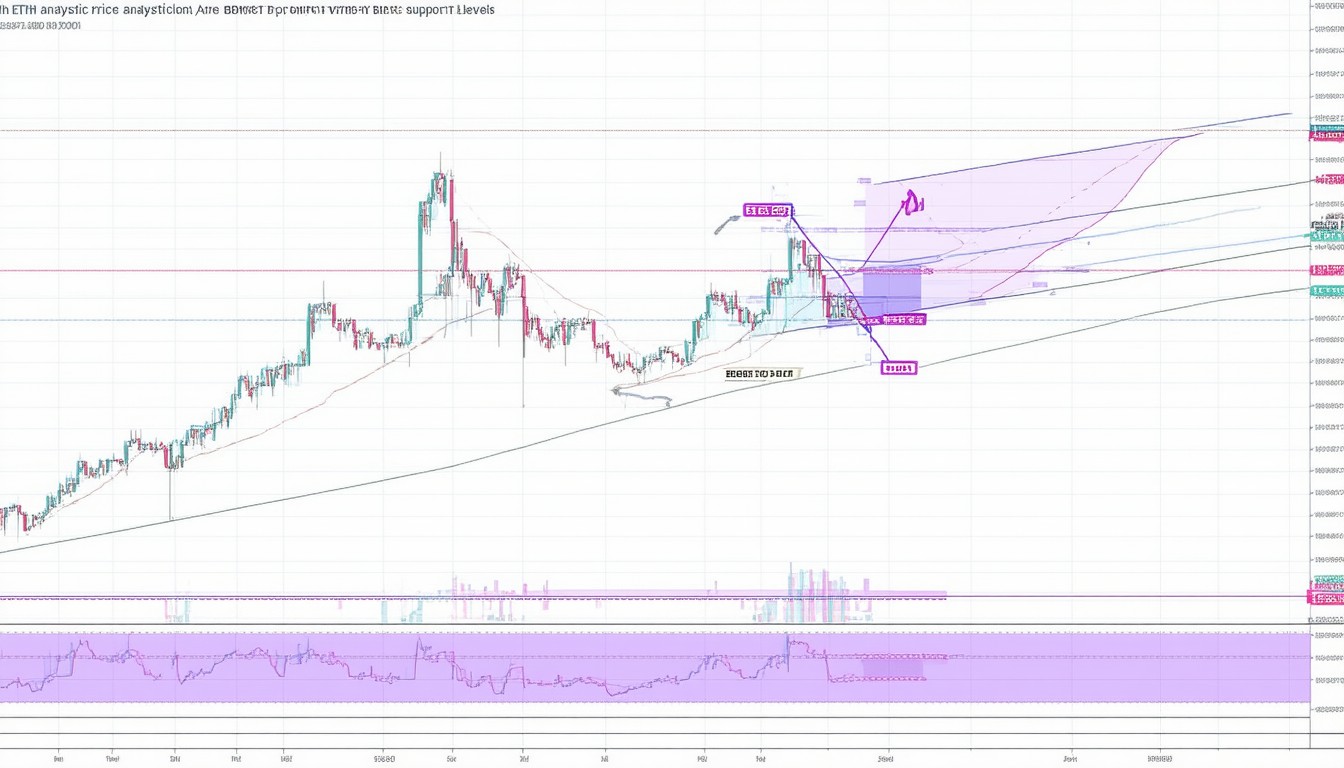
Some technical analysts identify resistance at historically significant levels around $2,500–$3,000, with support established near $1,500. Trading volumes and derivatives data suggest active accumulation among larger investors (whales), while retail participation is cyclical—often increasing during major news events.
Medium-to-Long Term Scenarios
Looking one to three years ahead, the integration of Ethereum 2.0 upgrades, combined with continual growth in DeFi and Web3, provide a constructive backdrop. Industry commentators highlight the likelihood of new all-time highs, contingent on network scalability and an improved regulatory environment.
A research summary from Messari notes that, “Under favorable conditions—including successful rollouts of protocol upgrades and increasing real-world adoption—Ethereum could see double-digit annualized growth.” Conversely, setbacks in upgrade timelines or restrictive regulation could delay major advances.
Real-World Examples: Ethereum in Action
The real-world influence of Ethereum is evidenced by a surge in decentralized applications and finance products built on its blockchain. For instance, leading DeFi platforms such as Uniswap and Aave process billions in daily volume and offer services from swapping tokens to lending and borrowing—functionality all powered by the Ethereum protocol.
Similarly, the NFT boom that took hold in 2021 remains predominantly Ethereum-driven, with platforms like OpenSea seeing a vast majority of their asset listings—and sales—denominated in ETH. This utility translates into strong demand for Ethereum, especially as new use cases continue to emerge.
Technical Analysis: Chart Patterns and Momentum
From a technical standpoint, Ethereum’s price charts reveal cyclical patterns influenced by both internal innovation and external sentiment. Analysts monitor moving averages, Fibonacci retracements, and on-chain metrics—such as active addresses and gas fees—for signs of trend reversals or momentum swings.
Bullish indicators often include:
- Sustained increases in total value locked (TVL) in DeFi protocols.
- Rising unique wallet addresses interacting with dApps.
- Compression of volatility, indicating potential for breakout moves.
On the other hand, high network congestion, prolonged fee spikes, or a decline in developer activity can serve as caution flags for price appreciation prospects.
Future Catalysts and Risks to Watch
While forecasts lean optimistic, the road ahead is not without uncertainty. Future catalysts for upward momentum include the mainstreaming of tokenized assets, further regulatory clarification, and global macroeconomic shifts—such as central bank rate adjustments—which can trigger renewed capital flows into digital assets.
Key risks involve hacking incidents, regulatory crackdowns, or delays in protocol improvements. The interplay of these elements shapes not just short-term volatility, but the overarching narrative around Ethereum as a foundational pillar of the decentralized web.
Conclusion: Navigating Ethereum’s Price Landscape
Ethereum’s price forecast is shaped by a combination of emerging technology, institutional participation, and economic forces. While near-term volatility persists, the long-term trajectory for Ethereum appears supported by strong fundamentals, continued innovation, and expanding real-world adoption. For investors and technology leaders, staying attuned to network upgrades, regulatory signals, and usage patterns is essential for informed decision-making in this evolving digital landscape.
FAQs
What factors most influence Ethereum’s price today?
Ethereum’s price is driven by technology upgrades, institutional demand, regulatory changes, and the broader adoption of DeFi and NFTs on its network.
Can Ethereum surpass its previous all-time highs?
If scalability improvements are successful and global crypto adoption continues, many analysts believe Ethereum could reach or exceed past record prices in the coming years.
Is Ethereum’s price tied to Bitcoin’s performance?
Ethereum often follows Bitcoin’s broader market movements, but unique network developments or large-scale protocol upgrades can cause it to outperform during certain periods.
How do upgrades like Ethereum 2.0 affect price outlook?
Major upgrades that enhance scalability, efficiency, and usability often attract more users and developers, supporting ETH price appreciation over time.
Are there risks to investing in Ethereum now?
Key risks include unresolved regulatory uncertainty, potential delays in network upgrades, and increasing competition from alternative blockchain platforms.
What real-world uses support Ethereum’s long-term value?
Ethereum underpins DeFi applications, NFT platforms, and smart contract innovations—sectors that continue to expand as blockchain adoption grows globally.